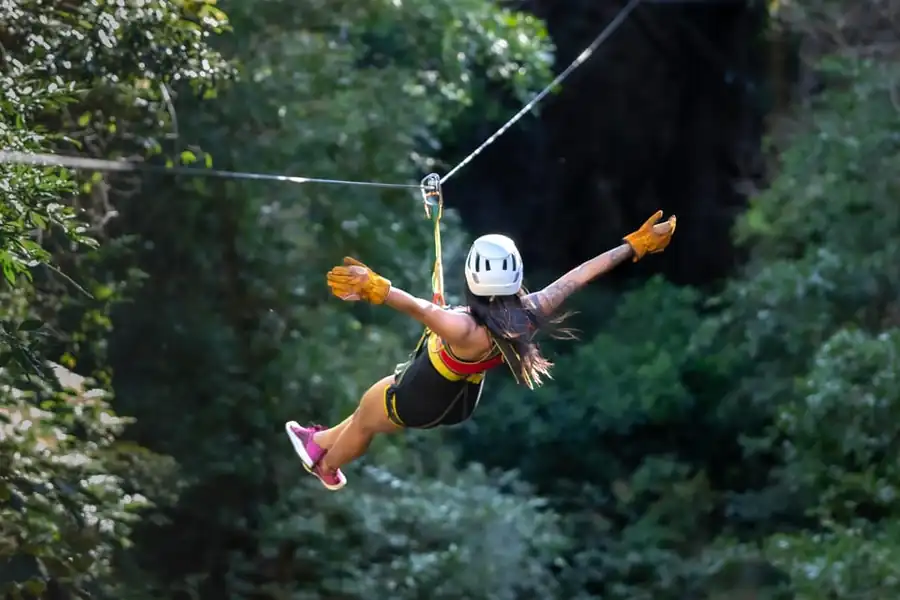
Ziplining is one of those things many visitors to Costa Rica want to try and feel a little nervous about at the same time. In Costa Rica people simply call it “canopy”. The reassuring part is how little it asks of your body: you do not climb ropes, you do not steer, and while you are on the line you hang from a steel cable in a harness. This guide walks you through a first time, so nothing on the day catches you off guard.
Is ziplining safe?
On a well-run course, safety comes from three things working together: the gear, the briefing and the people on the platforms. On our canopy tour near Tamarindo you wear a harness and a helmet, you get a safety briefing before the first cable, and trained staff accompany you on every platform. You are never left alone to connect yourself or to guess what comes next.
Your part is short: listen during the briefing, keep your hands where the staff show you, and wait for the signal before you go. Most of the scary stories people imagine involve guests improvising, so following instructions is the best safety tool you bring. If you like to read up before a trip, the Costa Rica Tourism Board (ICT) is the official body for tourism in the country.
How a canopy tour works, step by step
- Gearing up. Staff fit your harness and helmet and check that the straps are snug. If something pinches or feels loose, say so: adjusting it is part of their job.
- The briefing. Before the first line, someone explains how to hold on, what body position to keep and how they will signal you to start and to get ready for the arrival. Ask anything here. No question is silly when you are about to step off a platform.
- Connecting. On each platform a staff member attaches your harness to the cable with the pulley and the safety line. You do not handle the connections yourself.
- The ride. You sit back into the harness, let it carry your weight and glide. The pulley does the work; you just hold the position you were shown.
- The arrival. Staff at the next platform receive you and handle the cable. Then the routine starts again on the next line.
After two or three cables the routine feels familiar, and that is usually the moment people stop staring at the pulley and start looking at the forest below.
Afraid of heights? What actually helps
Plenty of first-timers arrive with a knot in their stomach, and a good number of them finish the tour asking to do it again. These tricks come up again and again:
- Tell the staff at the start. They see nervous guests every day and can give you an extra explanation, a moment to breathe or a calm countdown.
- Go in the middle of the group. Watching a few people go first shows you exactly what will happen, and you will not be waiting alone at the end.
- Look at the far platform, not down. Pick a point at the end of the line and keep your eyes there.
- Exhale as you leave the platform. A long breath out relaxes your shoulders and your grip.
- Remember who holds you. The harness carries your weight. Your hands are there for posture, not to hold yourself up.
Feeling scared on the first cable is completely normal. The second one usually feels different.
Who can go: age and weight limits
The minimum age is 8 and the maximum weight is 120 kg (about 264 lb) per person. These limits are there for the safety of everyone on the course, so if someone in your group is close to either one, write to us before booking and we confirm it. Children of 8 and older usually love it; younger kids in the family can enjoy the Tamarindo Estuary boat tour instead, which is suitable for all ages.
What to wear
- Closed shoes that stay firmly on your feet. Flip-flops and loose sandals can slip off in the middle of a cable.
- Comfortable clothes you can move in. The harness straps go around your legs, so very short shorts can rub; light pants or longer shorts work well.
- A hair tie if you have long hair, so it stays away from the pulley.
- Nothing loose. Leave dangling jewelry, scarves and hats without a strap at your hotel.
- Sunscreen and water for before and after; Guanacaste is hot most of the year.
Phones and cameras on the line
Everybody wants a video of their first ride. Ask the staff before you take out a phone or a camera, on the platform or on the cable: they tell you what is allowed on that course and how to secure it. Something dropped from a zipline falls a long way, and a loose strap near the pulley is a real problem. If the answer is no, enjoy the ride with both hands free. It is a better memory than a shaky video.
What the 2 to 3 hours look like
The whole experience takes about 2 to 3 hours, morning or afternoon. That time includes gearing up, the briefing, the cables themselves and the moves between platforms, so it depends on the size of the group and on how quickly everyone gets ready. You do not need to be athletic, but expect some walking and some waiting while the rest of the group crosses. Eat something light beforehand rather than a heavy lunch. Ask us about transport when you book.
Price and booking
The canopy tour costs $40 per person. That includes the harness, helmet and safety gear, the safety briefing and the trained staff on every platform. Pick your date and morning or afternoon on the booking page, or send us your questions first; we answer by WhatsApp.
Want the zipline inside a bigger adventure day?
Two of our full-day trips at the foot of Rincón de la Vieja Volcano include canopy among other activities:
| Day trip | Besides the canopy | Price |
|---|---|---|
| Cañón de la Vieja combo | Tubing, rafting, horseback riding, volcanic mud baths and lunch | $220 per person |
| Guachipelín combo | Horseback riding, tubing and natural hot springs | Price on request |
The differences between the two days are laid out in Cañón de la Vieja or Guachipelín. If rafting would also be a first, read rafting and tubing near Tamarindo. Ask us about the minimum age for each activity in a combo before you book.
Adrenaline one day, calm water the next
The canopy shows you the forest from above; the mangroves show you wildlife at water level. With a few days in Tamarindo, the zipline plus a morning on the mangrove kayak tour (minimum age 8, same as the canopy) is a balanced mix for active families and couples. Traveling with teenagers? Our guide to Tamarindo with teens has more ideas.
Updated November 10, 2026 · Written with the Conchita Tours guides.
Questions
Is ziplining scary the first time?
Most people feel nervous before the first cable, and that is normal. After one or two lines they relax, once they see that the harness carries their weight and that the staff handle every connection.
Do I need to be fit to go ziplining?
No special fitness is needed. You should be able to walk short distances and follow the staff’s instructions. The minimum age is 8 and the maximum weight is 120 kg per person.
Can I bring my phone on the zipline?
Ask the staff before using it. They tell you what is allowed on that course and how to secure it so it cannot fall.
How much is the canopy tour near Tamarindo?
$40 per person for about 2 to 3 hours, with harness, helmet, safety gear, a safety briefing and trained staff on every platform.
What should I wear for ziplining in Costa Rica?
Closed shoes, comfortable clothes you can move in and a hair tie if you have long hair. Leave flip-flops and loose items behind.