Tamarindo is a beach town, and the estuary next to it is calm water with no rapids at all. The rivers with white water are inland, coming down from the volcanoes of the Guanacaste range. That is where Conchita’s river activities happen: on the adventure combos at the foot of Rincón de la Vieja. Before you book one, it helps to know what you are signing up for, because rafting and tubing are two very different experiences.
Rafting vs tubing in one table
| Rafting | Tubing | |
|---|---|---|
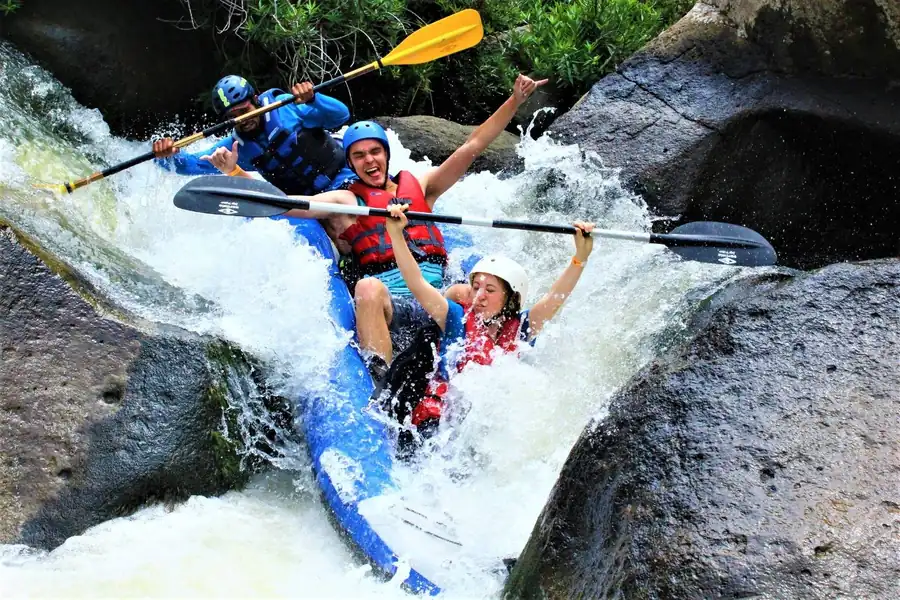
| What you ride | An inflatable raft for a small group | A large inflatable tube, one person per tube |
| Who steers | A river guide gives commands; everyone paddles | The current, with guides nearby to help |
| Effort | Moderate: you paddle as a team | Low: you sit, hold on and keep your feet up |
| Feeling | Teamwork, splashes, big waves | Bouncing, spinning, laughing |
| On which Conchita tour | Cañón de la Vieja combo | Cañón de la Vieja and Guachipelín combos |
What the rapid classes mean
Rivers are rated on an international scale from Class I to Class VI. The class describes how difficult a stretch of river is at a given water level. In general terms:
- Class I: moving water with small ripples. Easy.
- Class II: simple rapids with clear channels and some waves.
- Class III: stronger rapids, bigger waves and maneuvers that need teamwork. This is where commercial rafting starts to feel like real adventure.
- Class IV: powerful, technical rapids that need experience and precise paddling.
- Class V: long, violent rapids for experts only.
- Class VI: considered nearly impossible to run safely.
The same river can change class with the season and the rain, which is why we do not promise a class in advance. If the number matters to you, ask us what the river is running on your date.
What a river day looks like
Every river activity starts on dry land with a safety briefing. For rafting, the guide explains how to sit on the side of the raft, how to hold the paddle and the commands you will hear: forward, back, stop and “get down,” which means sliding into the raft and holding on. You also learn what to do if you fall in: float on your back with your feet up and pointing downstream, and wait for the guide or the rescue line. It sounds dramatic, but it is the same routine on every commercial river trip, and listening carefully is the most important thing you will do all day.
Tubing is simpler. You sit inside the tube, lean back, keep your feet up and let the river carry you, while the guides keep the group together and pull anyone who gets stuck back into the current. Expect to get spun around, splashed and, on the small drops, a little airborne.
Safety gear
The standard gear for river activities is a helmet and a life jacket, adjusted by the staff before you get in. Rafters also get a paddle. Keep both helmet and life jacket buckled the whole time you are on the water, even on calm stretches. If you have any doubt about the equipment on your date, ask us when you book.
Dry season vs rainy season
Guanacaste has a clear dry season, roughly from December to April, and a rainy season, roughly from May to November, according to the climate summaries of the national weather service, IMN. Rivers follow the rain:
- In the dry season the water is usually lower and slower. Rapids can be gentler, with more rocks showing.
- In the rainy season the water is usually higher and faster, with bigger waves and more power.
- After a heavy storm a river can rise quickly. Operators change or postpone river activities when the water is not safe, and that is a good thing.
What to wear
- A swimsuit under quick-drying shorts and a T-shirt or rash guard. Avoid cotton jeans.
- Shoes that stay on your feet: water shoes or sandals with a back strap. Flip-flops will be lost in the first rapid.
- Waterproof sunscreen, applied before you leave.
- A strap for your glasses, or leave them behind.
- No jewelry, and no phone on the river unless it is in a waterproof case attached to you.
- A dry change of clothes and a towel for later.
For the full list for a long day out, see what to bring on a full-day tour in Guanacaste.
Who should skip the rapids
Rafting and tubing are fun for most healthy travelers, but they are not for everyone. Skip them, or talk to us first, if you are pregnant, have back, neck or heart problems, have had recent surgery, or are under the minimum age for the activity (ask us, because each activity has its own). Do not go on the river after drinking alcohol. And if you are very afraid of water, a river is not the place to face that fear on vacation.
Which combo has which river activity
The Cañón de la Vieja combo ($220 per person) includes both tubing and rafting, plus canopy, horseback riding, volcanic mud baths and lunch. The Guachipelín combo (price on request) includes tubing but no rafting, and ends in natural hot springs. We compare both days in Cañón de la Vieja vs Guachipelín, and we put them next to the other volcano trips in volcano tours from Tamarindo.
Prefer calm water? Stay in the estuary
If rapids are not your thing, you can still spend a great morning on the water. The Tamarindo Estuary is a tidal river mouth with calm water among the mangroves. The kayak tour ($60 per person, minimum age 8) is easy paddling with a guide, no waves and no rapids, and the wildlife comes to you in silence: herons, howler monkeys, iguanas and, from a safe distance, crocodiles. The boat tour ($35 per person) needs no effort at all and suits every age. Not sure which one? Read boat or kayak in the Tamarindo Estuary, and if swimming is your worry, kayaking if you can’t swim.
Ready to choose? Send us your date through the booking page.
Updated November 10, 2026 · Written with the Conchita Tours guides.
Questions
What is the difference between rafting and tubing?
In rafting a small group paddles an inflatable raft through rapids following a river guide. In tubing each person sits in a large inflatable tube and floats down the river without paddling.
What class are the rapids near Rincón de la Vieja?
The class depends on the river level, which changes with the season and the rain, so we do not promise one in advance. Ask us what the river is running on your date.
Do I need to know how to swim for rafting or tubing?
You wear a life jacket and a helmet the whole time, but being comfortable in water helps a lot. If someone in your group cannot swim, tell us before booking and we advise you.
Can children go rafting or tubing?
Each activity has its own minimum age. Send us the ages of your children and we tell you what they can do.
Is there rafting in the Tamarindo Estuary?
No. The estuary is calm water with no rapids. It is perfect for the kayak and boat tours, while rafting happens on rivers inland, near Rincón de la Vieja.