Most tours around Tamarindo happen in the sun: on the water, in the forest, on the beach. A descent into the Barra Honda caverns is the opposite. For a while you leave the light behind and go into a hill that is hollow inside. People come back from it talking less about what they saw and more about how it felt. This page is about that: what happens on the way down, what you will see, and how to know if it is for you.
A hill that used to be a reef
Barra Honda National Park is in the canton of Nicoya, in the Guanacaste lowlands. Its main feature is a hill of limestone rising above the dry plains. Limestone is made from the shells and skeletons of sea creatures, and the rock of Barra Honda formed as an ancient reef under the sea. Over a very long time the land rose, the reef ended up high and dry, and rainwater, slightly acidic, slowly dissolved the rock from the inside. The result is a hill full of caverns, many of them connected to the surface only by a vertical opening.
Only some of those caves are open to visitors, under the rules of the park. The national system of conservation areas, SINAC, manages the park and decides which caves can be visited and how.
Step by step: the way down
- The hike. The day starts with a walk through the national park to the cave entrance, through dry tropical forest. It is hot, especially in the dry season, so pace yourself and drink water.
- Gearing up. At the entrance you put on the caving equipment included in the tour: typically a harness, a helmet and a headlamp. The guide checks every buckle.
- The descent. The way in is vertical, with ropes and ladders, while you stay attached for safety. This is the part that asks the most of your nerves: you go down one rung at a time, facing the rock, with the circle of daylight getting smaller above you.
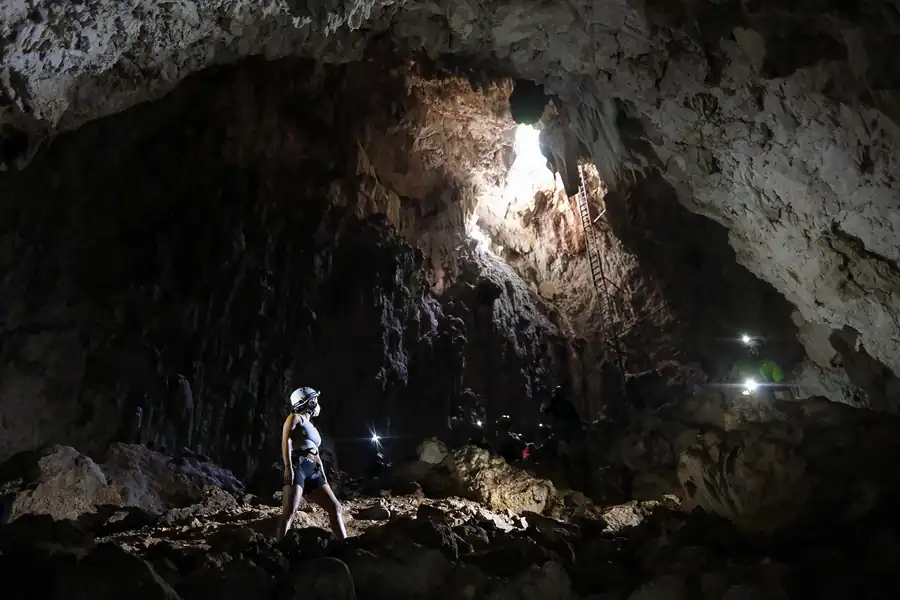
- Underground. At the bottom, the space opens up. You walk with your guide from chamber to chamber, with your headlamp as the main light.
- The way back up. The same ladders, now climbing. It is more effort than the descent, but there is no hurry.
What you see down there
Water dripping for thousands of years leaves tiny amounts of mineral behind, and those amounts slowly build shapes:
- Stalactites hang from the ceiling, like stone icicles.
- Stalagmites grow up from the floor, under the drips.
- Columns form when a stalactite and a stalagmite finally meet.
- Curtains and flowstone cover walls where water runs in thin sheets instead of drops.
Your guide will point out shapes that people have given nicknames to, and you may see bats resting on the ceiling. Then there is the moment many visitors remember most: if the guide asks everyone to switch off their lights for a few seconds, you experience complete darkness, the kind that does not exist above ground.
How it feels
Inside the cave the air is noticeably cooler than on the hot trail outside, and humid. Sounds change: voices echo, drops are loud, and outside noise disappears. Surfaces can be slippery and muddy, and you will touch the rock with your hands on the ladders. Expect to come out a bit dirty and very awake.
Fitness and claustrophobia: an honest check
You do not need to be an athlete, but the tour requires reasonable physical condition. Ask yourself three questions:
- Can I walk uphill in the heat for a while without trouble?
- Can I climb a ladder using my arms and legs, more than once?
- Am I comfortable with heights in a harness?
If the answer to all three is yes, you will be fine. As for claustrophobia: the chambers themselves are big, as the photo on this page shows, but the opening and the ladder section feel more enclosed, and it is dark. If you have a strong fear of enclosed spaces or of heights, talk to us before booking. People with heart conditions, recent injuries or pregnancy should skip the descent. For age limits, ask us.
What to wear and bring
- Closed shoes with good grip. Hiking shoes or sneakers with a solid sole. No sandals.
- Clothes that can get dirty. Light long pants protect your knees on the rock.
- Water. More than you think, for the hike.
- A small backpack that you can leave or carry as the guide indicates. Keep your hands free on the ladders.
- Sunscreen and repellent for the forest part.
For a full checklist for long days out, see what to bring on a full-day tour in Guanacaste.
Park rules worth knowing
- Do not touch the formations. The oils in your skin can stop them from growing, and they took thousands of years to form.
- Take nothing, leave nothing. No rocks, no pieces of formation, no trash.
- Stay with your guide and follow every instruction from the guide and the park rangers.
- Respect the bats and any wildlife: no flash at close range, no noise directed at them.
Weather and season
In the dry season, roughly December to April according to IMN, the forest is brown and the hike is hot; start well hydrated. In the rainy season the forest turns green and the hike is fresher, but heavy rain can affect access to the caves. Ask us whether the caves are open on your date before you plan around them.
Booking and pairing it with the estuary
The Barra Honda caverns tour includes the hike in the national park, the guided descent and the caving equipment. The price is on request: send us your date and group size and we reply with a quote. Ask us about pickup when you write. The drive from Tamarindo to Barra Honda is roughly 1 to 1.5 hours, depending on traffic and the road.
After a day underground, a quiet morning in the open air feels great. The estuary boat tour is two relaxed hours among mangroves, crocodiles and herons, and the kayak tour takes you into narrow channels in silence. If you are still choosing your inland day, compare the caves with the volcano trips in volcano tours from Tamarindo. When you are ready, send your date through the booking page.
Updated November 10, 2026 · Written with the Conchita Tours guides.
Questions
Is the Barra Honda cave tour scary?
The descent with ropes and ladders is the most intense part, especially for people who dislike heights. You are attached for safety and the guide goes step by step. Once at the bottom, the chambers are large.
Do I need caving experience?
No. The caving equipment is included and the guide explains everything. You need reasonable physical condition for the hike and the ladders.
Can children go into the Barra Honda caves?
It depends on their age and size, because of the descent and the harness. Ask us with the ages of your children before booking.
Are the caves open in the rainy season?
Heavy rain can affect access to the caves. Ask us whether they are open on your date before you plan your trip around them.
How much is the Barra Honda tour?
The price is on request. Send us your date and group size and we reply with a quote.