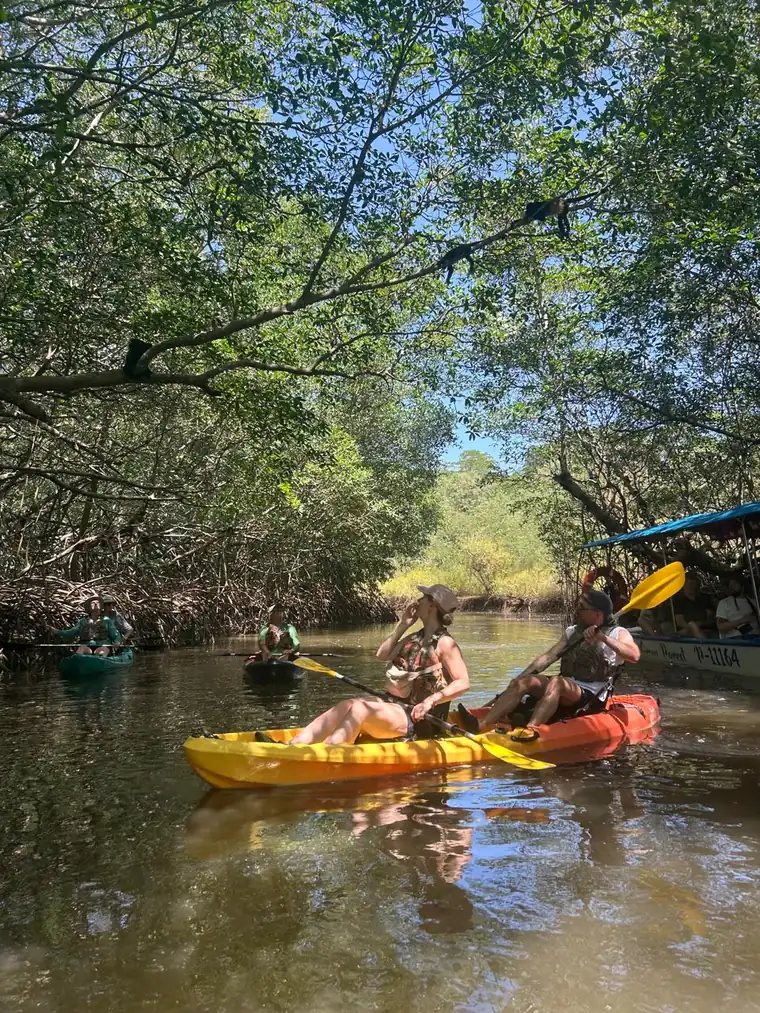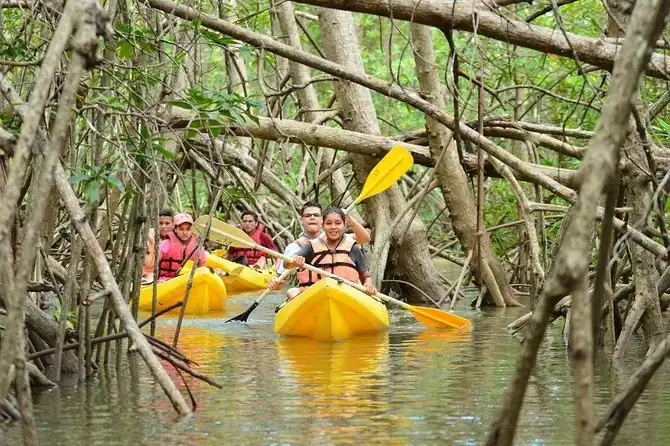
Most weekends in Tamarindo go like this: beach, surf lesson, sunset, repeat. Nothing wrong with that. But with a little planning, the same two days can also include a few hours among crocodiles, howler monkeys and herons in the mangroves, and a full day in the forest looking for sloths. This plan uses two of our tours, keeps the evenings free and leaves plenty of room for the sand.
The weekend at a glance
| Day | Activity | Time it takes | Price per person |
|---|---|---|---|
| Day 1 | Tamarindo Estuary by kayak or by boat | Kayak 2 to 3 hours, boat about 2 hours. Morning, midday or afternoon, depending on the tide | Kayak $60 · boat $35 |
| Day 1 | Beach, lunch in town and sunset | The rest of the day | Free time |
| Day 2 | Sloth watching tour in Bijagua | Full day, leaving in the morning | $220 (groups of 2 or 3) · $190 (4 or more) |
Day 1: the estuary, on the tide’s schedule
Walk to the north end of Tamarindo beach and the sand gives way to a green river mouth: that is the Tamarindo Estuary. A few minutes into the tour, the town disappears and you are moving between walls of mangrove roots. The catch is that there is no fixed timetable: the boat and the kayaks need enough water to get into the channels, so the departure time moves every day with the tide. When you book, you pick morning, midday or afternoon, and we confirm the exact time by WhatsApp. That is why day one is the flexible day of the weekend: the beach fits around the estuary, not the other way around.
Kayak or boat?
The kayak tour takes 2 to 3 hours and costs $60 per person. It includes the kayak, paddle, life jacket and a short paddling lesson, so you do not need experience; the water in the estuary is calm. Kayaks are silent and slip into narrow channels, which is why birds and monkeys often let you get closer. The minimum age is 8 and the maximum weight is 120 kg per person.
The boat tour takes about 2 hours and costs $35 per person. The boat is covered, you stay seated and life jackets are included. It works for every age and for anyone who would rather not paddle. If you are torn, our comparison of boat or kayak in the Tamarindo Estuary goes through the details.
Either way, keep your eyes on the mud banks and the treetops. The regulars are American crocodiles, howler monkeys, green iguanas, boat-billed and night herons, white ibises, kingfishers, the common black hawk and the red-and-black mangrove crabs on the trunks. They are wild animals, so sightings are likely but never guaranteed. Costa Rica’s conservation agency, SINAC, asks visitors not to feed or call wildlife, and your guide will remind you. What you should not expect in the mangroves are sloths. For that, there is day two.
The rest of day one
- If your tour is in the morning: have lunch in town, rest through the hottest hours and walk down to the beach in the late afternoon.
- If your tour is in the afternoon: swim and walk the sand early, while the light is gentle, have a light lunch and head to the mangroves later.
- Either way, end at the beach. Tamarindo faces west, which means every clear evening ends with the sun dropping into the Pacific. Get there a little early; it is the busiest half hour of the day on the sand.
Then have an early dinner. For lunch, look for a casado: rice and beans with salad, sweet plantain and your choice of chicken, fish or beef. It is the classic Tico refuel. Day two starts in the morning.
Day 2: sloths in Bijagua
Bijagua is a farming town between Tenorio and Miravalles volcanoes, in the north of the country. Up there the air is damp, the hills stay green most of the year, and sloths hang in the trees that line the farms and trails. Getting there takes roughly two and a half to three hours each way, depending on traffic and the road, which is why this is a full-day trip and not something to squeeze into an afternoon.
The sloth watching tour includes round-trip transport, breakfast, lunch and a naturalist guide. It costs $220 per person for groups of 2 or 3 and $190 per person from 4 people, with a minimum of 2. Card payments carry a 13% surcharge. Sloths are common in Bijagua and the guides know where to look, but, like everything in this plan, they are wild and no sighting is guaranteed. Besides sloths, keep an eye out for tropical birds and frogs.
Pack a light rain jacket, comfortable walking shoes, insect repellent and binoculars or a camera with zoom: sloths are often high up and well camouflaged. Our packing list for a full-day tour covers the rest. And if you are wondering why you have to drive to see them, read are there sloths in Tamarindo? or learn more about the town in our Bijagua guide.
Why the long day goes second
Putting the estuary first gives you room to arrive on day one in the morning or around midday and still catch a tide slot. The sloth tour has a fixed date, so it is the one you lock in first. If you fly out right after the weekend, a quiet evening after Bijagua is the best way to close it.
Plan B: rain, or kids under 8
If it rains. Between May and November, the rainy months, clouds tend to stack up after lunch and break into showers. You can check the regional outlook on the website of the national weather service, the IMN. If the forecast looks wet, switch the kayak for the boat: it has a roof, so a drizzle does not ruin the outing. The sloth tour goes to a rainy region anyway, which is part of why it is so green; just bring the rain jacket.
If you travel with children under 8. The kayak tour has a minimum age of 8, so book the boat instead. It is suitable for all ages and everyone wears a life jacket. For the sloth tour, tell us the children’s ages when you book.
Plan C: skip the long drive
Roughly five to six hours of road in total is a lot for some travelers on a two-day trip. If you would rather stay close to Tamarindo on day two, swap Bijagua for one of these:
- Horseback riding, 2 to 3 hours through beaches, dry forest and country trails, $40 per person. Beginners are welcome; the maximum weight is 120 kg.
- Canopy zip-line, 2 to 3 hours above the forest, $40 per person, safety gear included, minimum age 8.
- The other half of the estuary: if you took the boat on day one, paddle the narrow channels by kayak on day two, or the other way around.
You will not see sloths with this version, so be honest with yourself about what matters most on this trip.
Booking tips that save the weekend
- Book the sloth tour first. It is a full day with a minimum of two people. The estuary is easier to place once you know the tide.
- Send us your dates and the ages of the group through the booking page or by WhatsApp and email. We tell you which estuary slot the tide allows on your day.
- Give yourself some notice in busy weeks. Tamarindo is busiest in the sunny months, December through April, and around Easter week and the year-end holidays.
Food, water and rest
- Eat before the estuary, but lightly, and bring water, sunscreen and a hat.
- On sloth day, breakfast and lunch are included. Bring water and a snack if you get hungry between meals.
- Guanacaste is hot. Plan the beach for early or late in the day and rest at midday.
Have more than two days? Our five days in Guanacaste from Tamarindo adds volcanoes, a wetland and a cave, all without changing hotels.
Updated November 10, 2026 · Written with the Conchita Tours guides.
Questions
Can I do the kayak tour and the sloth tour on the same day?
It is not a good idea. The sloth tour is a full day that leaves in the morning, and the estuary departure time depends on the tide. Give each one its own day.
How much does this weekend cost per person?
The kayak tour is $60 per person (or the boat, $35). The sloth tour is $220 per person for groups of 2 or 3 and $190 per person from 4 people, with transport, breakfast, lunch and guide included.
What time does the estuary tour leave?
It depends on the tide. You choose morning, midday or afternoon when you book and we confirm the exact time by WhatsApp.
Will I see sloths in the Tamarindo Estuary?
The estuary is not a sloth tour. Its regulars are crocodiles, howler monkeys, herons and iguanas. To look for sloths, book the Bijagua tour on day two.
What if it rains during our weekend?
Switch the kayak for the covered boat and bring a light rain jacket to Bijagua. In the green season, rain usually comes later in the day.