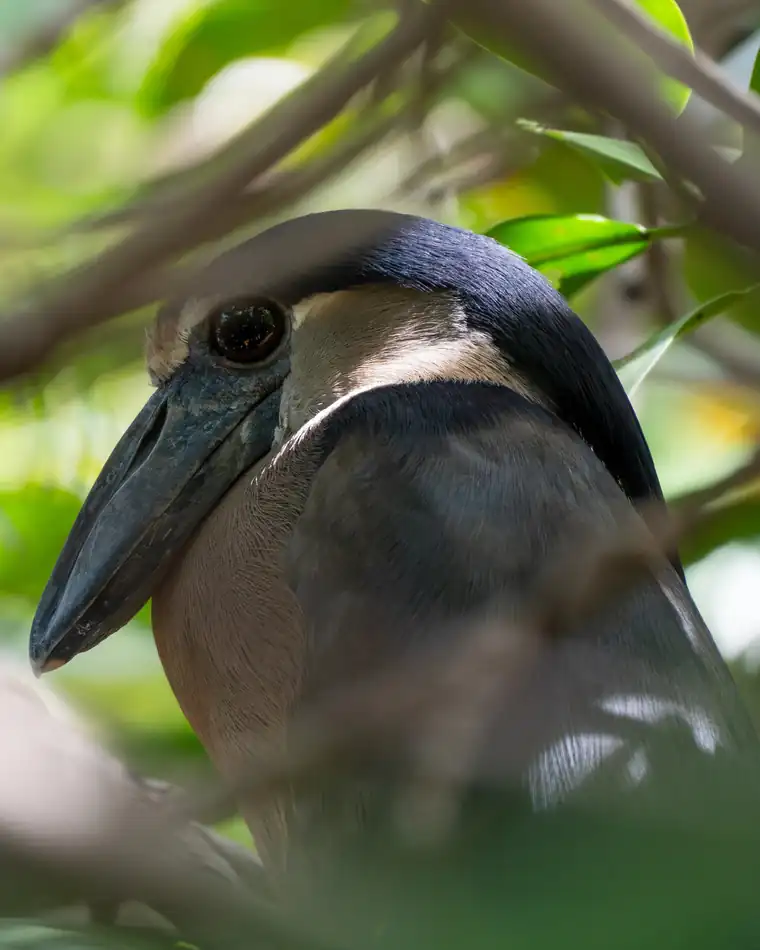
Ask our guides which bird makes guests laugh out loud, and the answer is almost always the same. The boat-billed heron sits very still in the shade, looks at you with two enormous black eyes and shows off a bill that seems borrowed from a different animal. It is one of the signature birds of the Tamarindo Estuary, and with a bit of patience you have a good chance of seeing one on a tour.
Name and look
Its scientific name is Cochlearius cochlearius, from a Latin word for spoon, and in Costa Rica it is also called chocuaco. It is a medium-sized heron, compact and hunched. Adults have a black cap with a crest that hangs down the back of the head, a pale gray or whitish face and chest, a warm cinnamon belly and black on the sides. Young birds are browner and plainer, but the bill gives them away at any age.
A day in its life, hour by hour
Daytime: asleep in the shade
When most tours are on the water, the boat-billed heron is resting. It perches on branches inside the mangrove, often low and close to the water, tucked into the deepest shade it can find. It sits hunched, neck pulled in, and unless something disturbs it, it hardly moves. Several birds often roost near one another, so where you see one, look around for more.
Dusk: the shift change
As the light fades, roles swap in the mangrove. Day birds settle down, and the night herons start to move. The boat-billed heron wakes up, stretches and heads to the water’s edge or to low branches over the channels.
Night: the hunt
Now the big eyes earn their keep. Large eyes gather more light, which helps the bird see movement in the dark water. It hunts mostly by waiting, standing still on a root or in shallow water, then strikes fast. It eats fish, shrimp, crabs, frogs and insects, whatever moves within reach.
Why such a strange bill?
Most herons have a long, dagger-like bill for spearing. The boat-billed heron’s is short, very wide and slightly hooked at the tip. Researchers describe it using the bill to scoop prey from the water and to snap shut quickly on whatever it touches. A wide mouth also helps when your prey is a slippery shrimp you can barely see. If you are curious about another wetland bird with an odd bill, compare it with the roseate spoonbill, which sweeps its flat bill from side to side instead.
Colonies and bill clapping
Boat-billed herons often nest in groups in trees over the water, sometimes alongside other herons. They are not songbirds: their sounds are croaks, low calls and a dry clapping or popping made with the bill, especially around the nest. If you hear a sharp clack from deep in the mangrove, it may be one of them.
Why the Tamarindo Estuary suits it so well
- Dense shade by day. Mangrove canopies give it dark, cool places to sleep close to the water.
- Food at night. The channels are full of small fish, shrimp and crabs, the menu it likes best.
- Low branches over the water. Perfect for both roosting and hunting without moving far.
- Protection. Mangroves are protected ecosystems in Costa Rica; the Ministry of Environment (MINAE) and SINAC are the official sources on how they are managed.
How our guides find one
Spotting a sleeping, motionless bird in deep shade takes practice. Guides scan the lowest, darkest branches along the channel walls rather than the open treetops. They look for a rounded, hunched shape with a pale face, and often they catch the shine of one large eye before anything else. Knowing where birds have roosted on previous trips helps too. When the guide spots one, the boat slows down and the group gets a good look without anyone shouting or pointing wildly.
Kayak or boat for this bird?
Both work, and each has its own advantage:
- From the kayak you are at eye level with low roosts and you make no engine noise, so you can enjoy a calm view. Keep your distance anyway: do not paddle under the branch, avoid sudden movements and speak softly. A heron that flies off in daylight loses its rest.
- From the covered boat you have a higher, steadier platform, which is better for binoculars and long camera lenses, and it is the choice for small kids and anyone who prefers not to paddle.
Whichever you pick, skip the flash: a burst of light in the eyes of a night bird is the last thing it needs. Not sure which tour suits your group? Read boat or kayak in the Tamarindo Estuary.
Its neighbors in the mangrove
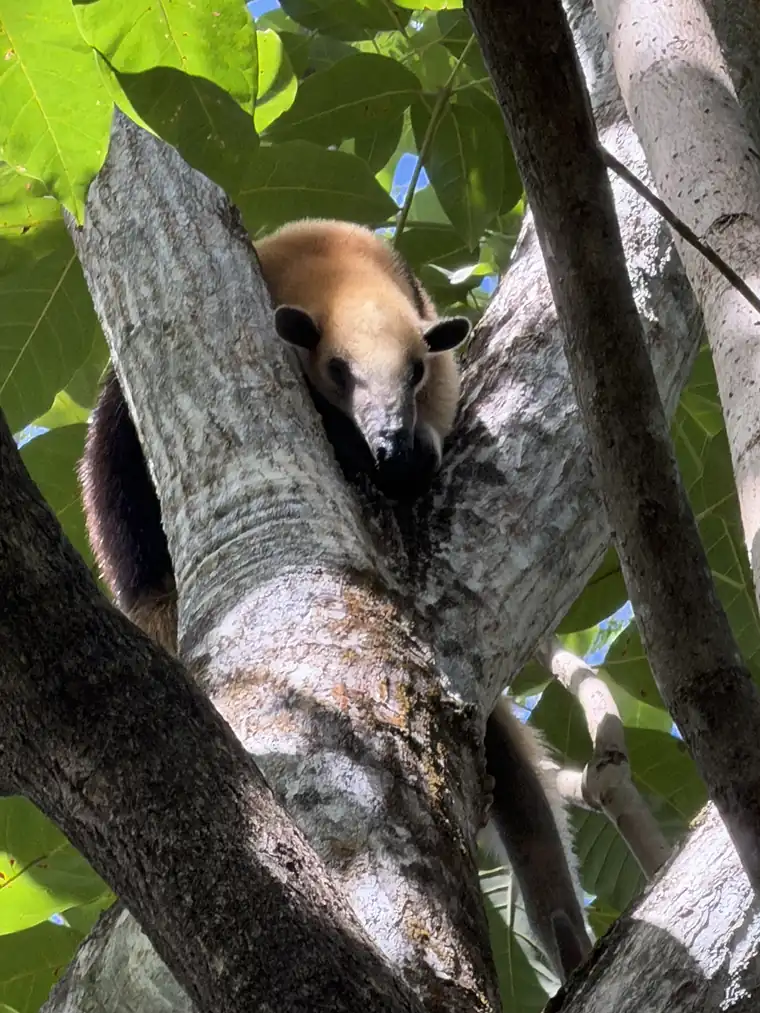
On the same trip you may also see night herons, small green herons on the roots, white ibises and kingfishers, plus the common black hawk hunting crabs from a low perch. With luck, even a tamandua climbing a trunk. The full list is in our guide to Tamarindo Estuary wildlife.
Want to meet the chocuaco in person? Book the boat or kayak tour and ask your guide to keep an eye out for it.
Updated November 10, 2026 · Written with the Conchita Tours guides.
Questions
Can you see boat-billed herons in the Tamarindo Estuary?
Yes, they are among the birds our guides find most often, resting by day in the shade of the mangroves. They are wild, so a sighting is likely but never guaranteed.
Why does the boat-billed heron have such big eyes?
It feeds mainly at night. Large eyes gather more light and help it detect prey moving in dark water.
What does the boat-billed heron eat?
Fish, shrimp, crabs, frogs and insects, which it catches by waiting at the water’s edge and striking quickly with its wide bill.
Is it better to see it by boat or by kayak?
Both work. The kayak is quiet and at eye level with low roosts; the boat is steadier for binoculars and cameras and suits all ages. In either case, keep your distance and do not use flash.