Many visitors hear it before they know what it is: a deep, rolling roar coming out of the trees at first light, loud enough to sound like a large predator. In Costa Rica the source is the mantled howler monkey (Alouatta palliata), known to Costa Ricans as the mono congo. It is a calm, leaf-eating monkey that spends most of the day sitting still. The noise is simply its way of talking to the neighbors.
Meet the mantled howler
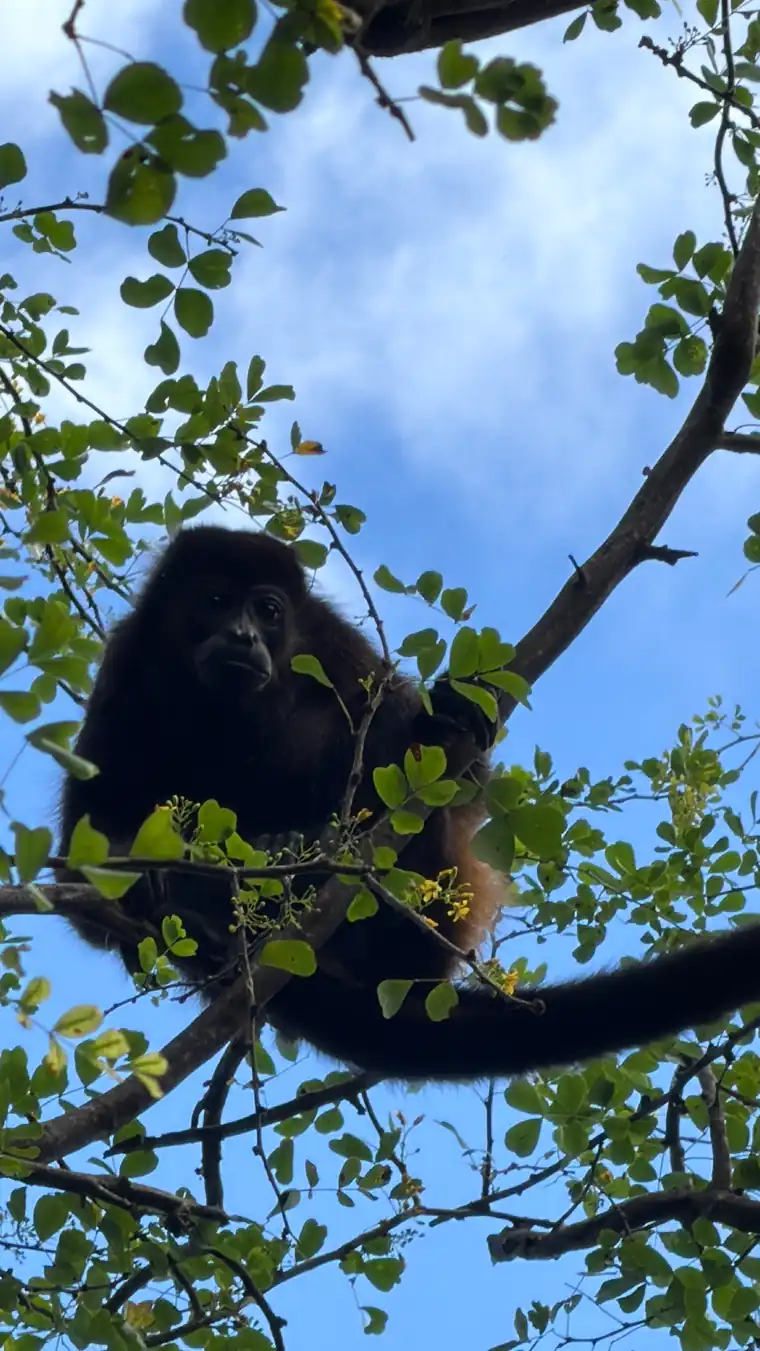
Mantled howlers are black, with a fringe of golden-brown hair along the flanks that gives them their name: the "mantle." Adults are stocky and have a strong prehensile tail that works like a fifth hand, wrapping around a branch while they feed or doze. They live in troops that usually include one or more adult males, several females and their young. In the Tamarindo Estuary they use the tall trees along the edge of the mangrove and the dry forest just behind it.
Guanacaste has two other monkeys, the white-faced capuchin and the spider monkey, but the howler is the one whose voice you will remember.
How such a small animal makes such a big sound
The secret is in the throat. Howler monkeys have an enlarged, hollow hyoid bone, the small bone at the base of the tongue that in people goes unnoticed. In howlers it forms a resonating chamber that amplifies the sound coming from the larynx, a bit like the wooden body of a guitar amplifies a string. Males have the larger chamber and the deepest voices, so the strongest roars usually come from them, although females and juveniles join the chorus too.
The result is one of the loudest calls of any land animal. On a still morning, a troop can be heard from far across the estuary and the hills, much farther than you would expect from an animal that fits comfortably on a branch.
Why they howl
To say "this patch is taken"
Howling is mostly about territory and spacing. Each troop uses an area of forest where it feeds and sleeps. By calling, a troop tells other troops exactly where it is. The neighbors answer, and both groups can keep their distance without ever having to meet. For an animal on a low-energy diet, avoiding a confrontation is a big saving: a chase through the canopy burns calories that leaves do not easily give back.
At dawn more than at any other time
The loudest chorus usually comes at first light, when troops announce themselves before they start feeding. You can also hear shorter bouts later in the day, often in the late afternoon.
When something loud happens
Howlers often answer sudden noises: thunder, a heavy shower moving in, a low plane, a chainsaw or an engine. Locals like to say the congos forecast the rain, and there is some truth to it, because the wind and thunder of an approaching storm often set them off. Another troop howling nearby will almost always get a reply.
A diet that explains their calm
If howlers are so loud, why do they look so lazy? Because of what they eat. Their diet is mostly leaves, plus fruit and flowers when they are in season. Leaves are easy to find but low in energy and slow to digest, so howlers rest for many hours a day while their gut does the work. They move slowly and deliberately and rarely waste effort. Seen that way, howling is a clever deal: a few minutes of noise defends the territory without a tiring patrol.
That calm is good news for you. A troop resting in a tree can stay in the same spot for a long time, which gives everyone on the water a chance to find it.
How to hear and see them in the estuary
On the Tamarindo Estuary boat tour and the mangrove kayak tour, howler monkeys are among the animals our guides point out most often. They are wild, so a sighting is likely on many trips but never guaranteed. A few habits make a real difference:
- Listen first. A roar tells you roughly where the troop is. Your guide uses it to decide where to slow down.
- Look up, then look higher. Howlers sit in the upper branches, often against the sky. Search for a dark lump on a branch, a tail hanging down like a rope, or leaves shaking when there is no wind.
- Keep your voice down. Talking and splashing push animals deeper into the trees. On a kayak, stop paddling and drift when the guide signals.
- Bring binoculars. Faces, the golden mantle and babies clinging to their mothers are far easier to see up close.
For the techniques our guides use with every animal, from crocodiles to herons, read how to spot wildlife in Costa Rica. For an overview of everything that lives in the mangrove, see Tamarindo Estuary wildlife.
Three things not to do
Don't imitate them
It is tempting to roar back. Please don't. Copying their call can make a troop react as if a rival were close, which stresses the animals, and it spoils the moment for everyone else on the water. The real sound is better anyway.
Don't feed them
Human food makes wild monkeys sick, teaches them to approach people and roads, and can end in bites. Feeding wildlife is harmful, and Costa Rica's environmental authorities ask visitors never to do it. You can read more on the website of SINAC, the agency that manages the country's protected areas.
Don't stand right under them
This one is practical. Monkeys relieve themselves from the branches, and a troop moving overhead can drop leaves, twigs and worse. If you find howlers above a path, watch from the side, not from directly below.
Plan your morning
Departure times follow the tide, so not every day starts at sunrise, but if you wake up early in Tamarindo you may well hear howlers from town. On the water, the covered boat suits every age, and the kayak lets you drift silently under the trees. Planning to paddle? Read kayaking near crocodiles in Tamarindo before you go. When you are ready, book your tour or send us your questions and we will help you choose.
Updated November 10, 2026 · Written with the Conchita Tours guides.
Questions
Are howler monkeys dangerous?
No. They are shy, spend their time high in the trees and avoid people. Just do not feed them, do not try to get close and do not stand directly under a troop.
What time of day do howler monkeys howl?
Mostly at dawn, with shorter bouts later in the day. They also tend to howl when rain or thunder is coming or after a sudden loud noise.
Can you hear howler monkeys from Tamarindo?
Quite possibly, especially early in the morning, depending on where you stay. On the estuary tour you are much closer to the trees where they rest.
Will we see howler monkeys on the estuary tour?
Our guides point them out on many trips, but they are wild animals, so a sighting is likely, never guaranteed.
Why do howler monkeys rest so much?
They eat mostly leaves, which give little energy and take a long time to digest. Resting for many hours a day saves that energy.