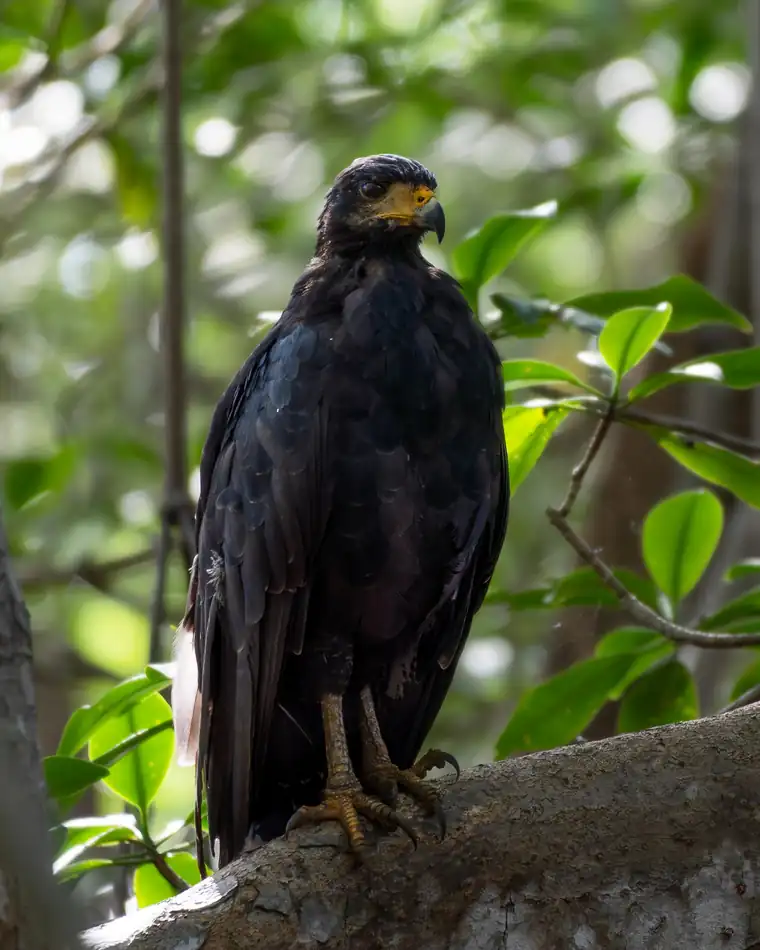
Many visitors look up at a dark bird circling over Tamarindo and say “vulture”. Sometimes they are right. In the mangroves, though, the dark bird sitting on a low branch with its eyes on the mud is often something far more interesting: a common black hawk, Buteogallus anthracinus, a raptor that has made the crabs of the mangrove its specialty. In Spanish it is the gavilán cangrejero, literally the “crab hawk”.
Field marks: how to recognize it
- Color: adults are sooty black or very dark gray all over.
- Tail: short and broad, crossed by one wide white band, with a thin white edge at the tip.
- Face and legs: bright yellow skin at the base of the bill and in front of the eyes, and long yellow legs.
- Wings: very broad and rounded. In flight, a small pale patch can show near the base of the outer flight feathers.
- Young birds: look different. They are brown with buff streaks and spots and have a tail with several thin bands. Many first-time birders take them for another species.
- Voice: a series of high, thin whistles, surprising from such a sturdy bird.
Black hawk or black vulture?
This is the most common mix-up in Guanacaste, because both birds are dark and both soar. Use this table the next time a black shape crosses the sky:
| Common black hawk | Black vulture | |
|---|---|---|
| Head | Feathered, with yellow skin at the base of the bill | Bare, wrinkled, dark gray |
| Tail | One bold white band across a black tail | Short and squared, all dark |
| Under the wings | Mostly dark; at most a small pale patch | Large whitish patches right at the wingtips |
| Legs | Long and yellow | Grayish white |
| Flight | Soaring circles on broad wings, often alone or in pairs | Quick flaps and short glides, often in groups |
| Where you see it | Low branches over mud and water | Over towns, roads and wherever there is carrion |
The third dark bird of the region, the turkey vulture, is easier: it has a red head, two-tone wings and rocks from side to side as it glides with the wings in a shallow V.
A specialist in crabs
A common black hawk will eat fish, frogs, lizards and insects, but in mangroves crabs are the main course. That makes sense: the mud and roots of the estuary are full of them, from small fiddler-type crabs to the colorful mangrove crabs that climb the trunks. A hawk that knows how to catch crabs never runs out of food.
How it hunts: patience from a low perch
Forget the image of an eagle diving from the clouds. The black hawk’s method is slow and close to the ground:
- It picks a perch just above the mud or the water, often a low branch or an exposed root.
- It waits, sometimes for a long time, scanning the ground below.
- When a crab wanders too far from its burrow, the hawk drops onto it with a short glide or a hop.
- It can also walk on the mud or in shallow water and grab prey on foot, which looks strange for a raptor but works.
Because it hunts so low, the black hawk is one of the raptors you can see well from water level. On the kayak tour you may be at the same height as the bird; on the boat tour you get a steadier view for binoculars. Either way, stay quiet and let the guide set the distance.
Where it lives
The common black hawk ranges from the southwestern United States and Mexico through Central America to northern South America. Along the Pacific coast of Central America, including Guanacaste, it is closely linked to mangroves, river mouths and coastal rivers. Some ornithologists treat the mangrove birds of the Pacific coast as a separate species, the mangrove black hawk; others consider them part of the same species. Either way, the bird you see in the Tamarindo Estuary is a mangrove specialist.
The mangrove food chain, in three links
The black hawk is the easiest way to understand how the mangrove works:
- Leaves. Mangrove trees drop leaves all year onto the mud.
- Crabs. Many mangrove crabs eat those fallen leaves and other debris, breaking them down and returning nutrients to the water. Their burrows also let air and water into the mud.
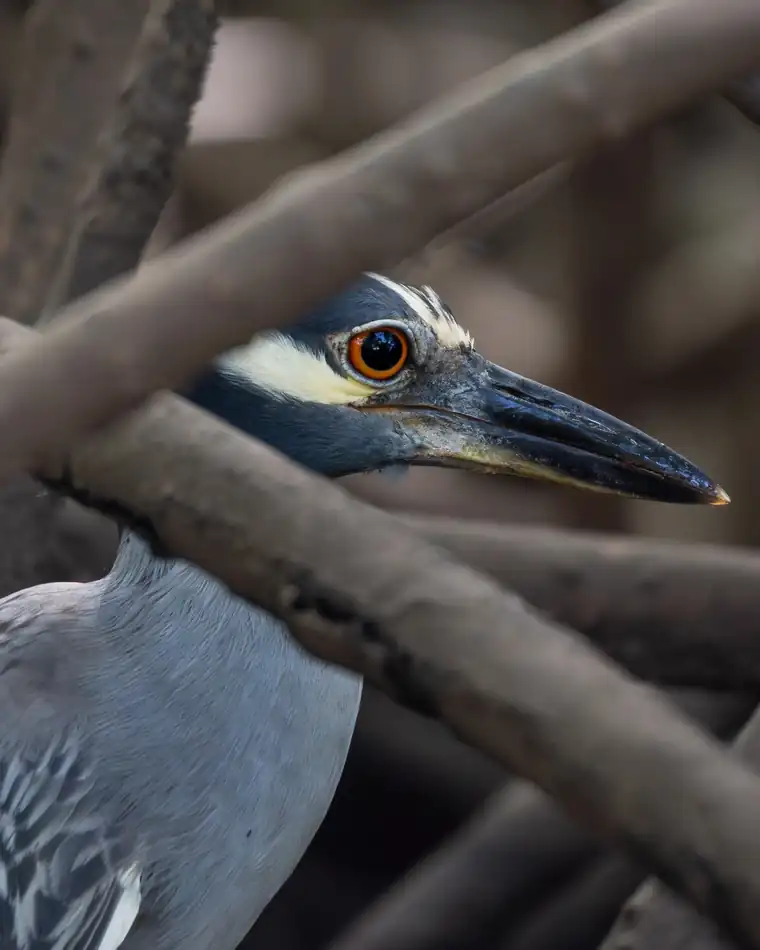
- Predators. The crabs feed the black hawk and also herons, raccoons and fish. Our boat-billed heron takes crabs at night, while the hawk hunts them by day.
Remove the crabs and the whole system suffers; that is one reason mangroves are protected in Costa Rica. The SINAC is the official agency for protected areas and wildlife. Globally the species is listed as Least Concern on the IUCN Red List, but it depends on healthy mangroves.
Seeing it on a tour
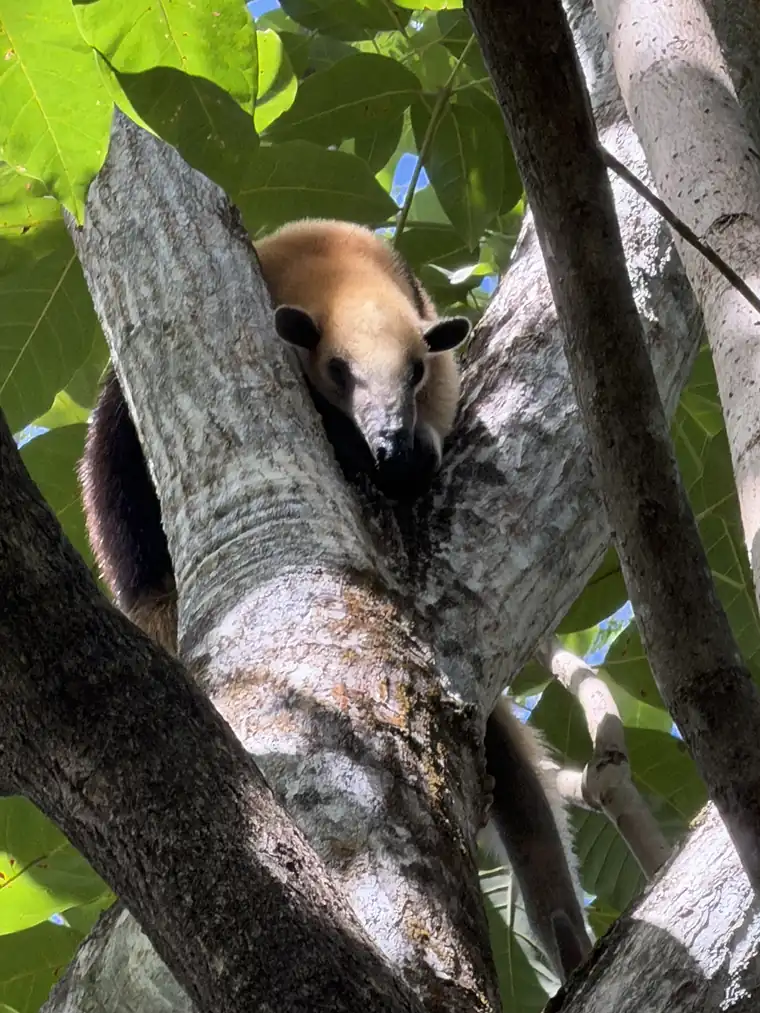
Common black hawks are regular residents of the estuary, and our guides often find one perched along the channels; still, wild birds come and go, so think “likely”, not “certain”. Look at low, bare branches facing open mud, and watch for that yellow face. If you hear high whistles, look up. Bring binoculars, and if birds are your thing, combine the estuary with a trip to Palo Verde: our comparison Tamarindo Estuary or Palo Verde explains what each place offers. For the rest of the cast of the mangrove, read Tamarindo Estuary wildlife and, for the lucky extras, the tamandua.
Questions before you go? Write to us and we help you choose between boat and kayak.
Updated November 10, 2026 · Written with the Conchita Tours guides.
Questions
What is the difference between a common black hawk and a black vulture?
The black hawk has a feathered head with yellow at the base of the bill, yellow legs and one wide white band on the tail. The black vulture has a bare gray head, an all-dark short tail and large white patches at the wingtips.
What does the common black hawk eat?
In mangroves it eats mainly crabs, which it catches by dropping from a low perch or walking on the mud. It also takes fish, frogs, lizards and insects.
Can you see common black hawks in Tamarindo?
Yes. They live in the mangroves of the Tamarindo Estuary and are often seen perched along the channels on the boat and kayak tours, although wild birds are never guaranteed.
Why is it called the crab hawk in Spanish?
Its Spanish name, gavilán cangrejero, means crab hawk, because crabs are its main food in mangroves and river mouths.