A pink bird wading in a Guanacaste wetland always raises the same question: "Is that a flamingo?" Almost always, the answer is no. It is a roseate spoonbill, one of the most photogenic waterbirds in Costa Rica, and once you know what to look for, it is impossible to confuse.
Why is it pink?
A spoonbill is not born pink. The color comes from its food. Spoonbills eat small crustaceans, aquatic insects and little fish, and many of those animals contain natural pigments called carotenoids, the same family of pigments that colors carrots and shrimp shells. The bird deposits part of those pigments in its feathers.
That has two visible effects. Young birds are pale, almost white with a pink wash, and they get pinker as they mature. Adults show the strongest color: a soft pink body with deeper, reddish pink on the shoulders, and a bare head with no feathers. A very pale spoonbill is usually a young bird, not a different species.
That strange bill, and how it feeds
The bill is long, flat and ends in a wide, rounded tip, like a spatula. The spoonbill feeds by touch, not by sight. It wades slowly through shallow water with the bill slightly open and swings it from side to side in wide arcs. When the tip touches a shrimp or a small fish, the bill snaps shut.
Because it does not need to see its prey, a spoonbill can feed in muddy, murky water where a heron would struggle. Watch for that sweeping motion: from a distance, a feeding group looks like a line of people looking for something lost in the water. Spoonbills often feed in small groups and mix with egrets, ibises and storks.
Where to see roseate spoonbills in Guanacaste
- Palo Verde and the Tempisque wetlands. This is the most likely place. In the dry season, roughly December to April, shrinking marshes and lagoons concentrate food, and spoonbills gather with other waterbirds. The Palo Verde boat tour on the Tempisque River is the trip to choose if this bird is on your list.
- Mangroves and coastal mudflats. Spoonbills also use mangrove edges and tidal flats along the Pacific coast, often at low tide.
- The Tamarindo Estuary. A spoonbill can show up in the estuary, and when it does, it is a lovely surprise. It is not a regular sighting, so we never promise it on the mangrove tours.
Wherever you go, these are wild birds: a sighting is likely in the right season and place, never guaranteed.
Spoonbill or flamingo?
Costa Rica has no resident wild flamingos. A stray bird may turn up very rarely, but a pink wader in a Guanacaste wetland is, in practice, a spoonbill. If you want to be sure, check these details:
- The bill. A spoonbill's bill is flat and straight with a spoon at the end. A flamingo's is thick and sharply bent in the middle.
- The way it feeds. The spoonbill sweeps its bill from side to side. A flamingo feeds with its head upside down, filtering the water.
- The shape. A flamingo is much taller, with very long legs and a long, curved neck. A spoonbill is more compact, about the size of a large heron.
Spoonbill or ibis?
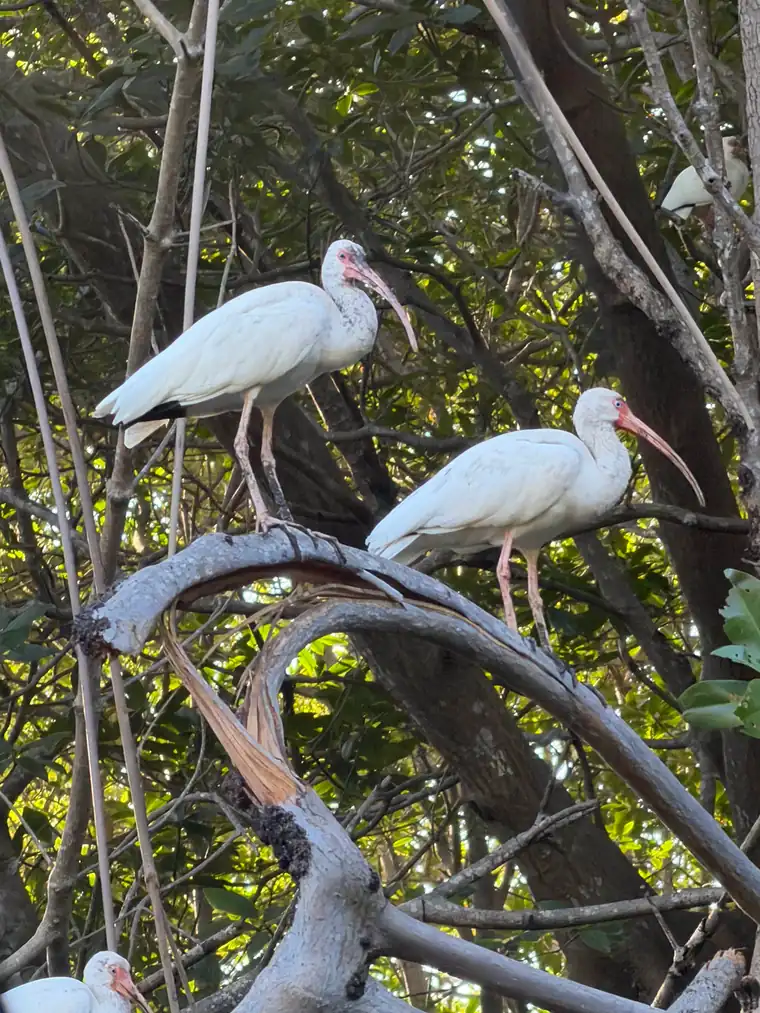
The photo at the top of this page shows two white ibises from the Tamarindo Estuary, the bird people most often mix up with a young, pale spoonbill. The quickest clue is the bill:
| Roseate spoonbill | White ibis | |
|---|---|---|
| Color | Pink, stronger on the shoulders; young birds pale | White adults; young birds brown and white |
| Bill | Flat and straight, with a spoon-shaped tip | Thin, curved downward, reddish orange |
| Feeding | Sweeps the bill side to side in the water | Probes the mud with the curved bill |
| In flight | Pink wings | White wings with black tips |
You can see white ibises regularly in the estuary mangroves; read about the other birds there in our guide to estuary wildlife.
Tips for watching and photographing spoonbills
- Bring binoculars. Spoonbills often feed in open water, away from the boat.
- Look for the motion before the color. In the glare of midday, the side-to-side sweep is easier to spot than a pale pink shape.
- Protect the pink. Bright pink overexposes easily. If your camera allows it, lower the exposure a little so the feathers keep their detail.
- Soft light is your friend. Morning and late afternoon light makes the color look richer than harsh midday sun.
- Use burst mode when a group lifts off. The pink wings open all at once, and that is the shot everybody wants.
- Stay seated and quiet. Never ask the boat to push the birds to make them fly. A relaxed group keeps feeding and gives you more time.
Plan your bird day
For your best chance at spoonbills, plan the Palo Verde boat tour ($160 per person, full day) in the dry season. The same wetlands are home to the jabiru stork, and our Tamarindo Estuary vs Palo Verde guide helps you decide between a full day and a short outing. Closer to town, the estuary boat tour and the mangrove kayak tour show you herons, ibises and kingfishers up close. Questions about dates? Write to us.
Updated November 10, 2026 · Written with the Conchita Tours guides.
Questions
Are there flamingos in Costa Rica?
Costa Rica has no resident wild flamingos. A stray may appear very rarely, but a pink wading bird in a Guanacaste wetland is almost always a roseate spoonbill.
Why are roseate spoonbills pink?
Because of their diet. The crustaceans, insects and small fish they eat contain natural pigments called carotenoids, which the bird deposits in its feathers. Young birds are paler.
Where is the best place to see a roseate spoonbill in Guanacaste?
The wetlands of Palo Verde and the Tempisque River, especially in the dry season from about December to April. They also use mangroves and coastal mudflats.
Can I see spoonbills on the Tamarindo Estuary tour?
Sometimes one appears in the estuary, but it is not a regular sighting, so we do not promise it. Herons, white ibises and kingfishers are much more common there.