Ask a group of birders in Guanacaste which bird they would most like to see, and many will say the jabiru. It is one of the tallest flying birds in the Americas, it looks almost prehistoric when it lifts off, and in Costa Rica it is genuinely scarce. Most travelers who see one do it in the wetlands of the Tempisque River, in and around Palo Verde National Park.
How to recognize a jabiru
Once you have seen one, you will not confuse it with anything else. Look for these features:
- Size. An adult stands roughly 1.2 to 1.5 meters tall (about four to five feet), and its wingspan is well over two meters. Next to egrets and herons, it looks enormous.
- Bare black head and neck. The head and most of the neck have no feathers, just black skin.
- A red collar. At the base of the neck there is a wide band of bare red skin, the detail that gives the bird its striking look.
- A huge bill. Black, very thick and long, with a slight upward tilt toward the tip.
- White body. The body and the wings are completely white.
In flight, a jabiru holds its neck straight out in front and its legs straight behind, with slow, heavy wingbeats. On hot days pairs often rise in circles on warm air, like vultures, which makes them visible from far away.
Jabiru or wood stork?
The wood stork, the other large stork of Guanacaste's wetlands, is the bird most often mistaken for a young or distant jabiru. The wood stork is clearly smaller, its head is grey and scaly rather than black, its bill curves downward instead of upward, and in flight it shows black feathers along the back edge of the wings. A jabiru's wings are all white.
What it eats and where it nests
The jabiru feeds in shallow fresh water. It walks slowly through marshes and lagoon edges, probing and grabbing fish, frogs, snails, insects and small reptiles. That is why the dry season suits it: as the marshes shrink, prey becomes concentrated in the pools that are left, and feeding gets easier.
Pairs build very large stick nests high in tall, often isolated trees near the wetlands, and the same nest can be used again in later years. Nesting in northern Costa Rica happens mainly in the dry months. Like other storks, jabirus are mostly silent; around the nest they communicate by clattering their bills.
A rare bird in Costa Rica
Across its whole range, from Mexico to South America, the jabiru is a widespread bird. In Costa Rica, however, it is scarce and is considered an endangered species, so every nest and every pair matters. The loss and drainage of wetlands and disturbance at nesting trees are among the pressures that affect large waterbirds like this one. Wildlife in Costa Rica is protected by law, and the authority in charge of protected areas and wildlife is SINAC. We do not quote population numbers here, because they vary from year to year and should come from official counts.
Where and when you are most likely to see one
Your best chance in Guanacaste is in the seasonal wetlands of the lower Tempisque basin, and Palo Verde is the classic place. Timing matters more than anything:
- Dry season, roughly December to April. The wetlands dry out, birds gather around the remaining water and big birds are easier to find in the open.
- Rainy season. Water spreads over a much larger area and the birds disperse, so sightings become less predictable.
- Time of day. Mornings are usually more active and more comfortable. In the midday heat, look up: soaring birds are easier to spot then.
Even in the best months, a jabiru sighting is never guaranteed. It is a rare bird, and that is part of what makes the moment special. The jabiru is not one of the birds we expect in the mangroves of the Tamarindo Estuary.
How to watch it with respect
- Keep your distance, especially near nests. A disturbed pair can abandon a nest. If the bird stops feeding and stares at you, you are too close.
- Stay low and quiet. On a boat, remain seated and let the guide set the approach.
- Leave the drone at home. Large birds read a drone as a threat.
- Never chase a bird to make it fly for a photo. The flight shot is not worth the stress for the animal.
- Bring binoculars (8x or 10x is ideal) and, if you photograph, a long zoom. Jabirus often feed far out in the marsh.
Looking for jabirus with us
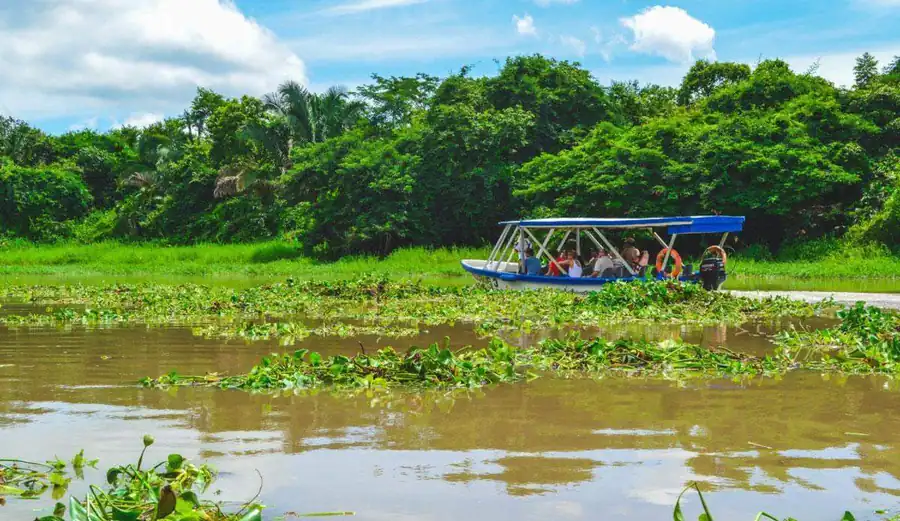
Our Palo Verde boat tour runs on the Tempisque River with an expert guide in flora and fauna, for $160 per person. It is a full-day trip; plan it for the dry season if the jabiru is on your list, and tell us when you write to us so the guide knows. Compare it with the mangrove tours in Tamarindo Estuary vs Palo Verde, and read about another pink-and-white star of the same wetlands, the roseate spoonbill.
If you only have a couple of hours, the estuary has its own remarkable birds, seen much closer: the boat-billed heron, night herons, white ibises and the common black hawk. You can see them on the estuary boat tour or, in silence and at water level, on the mangrove kayak tour.
Updated November 10, 2026 · Written with the Conchita Tours guides.
Questions
Where can I see a jabiru in Costa Rica?
Mainly in the seasonal wetlands of the lower Tempisque River in Guanacaste, with Palo Verde National Park as the classic place. It is a rare bird, so sightings are never guaranteed.
When is the best time to see jabirus in Palo Verde?
The dry season, roughly December to April, when the wetlands shrink and large birds gather around the remaining water.
How big is a jabiru stork?
An adult stands roughly 1.2 to 1.5 meters tall, and its wingspan is well over two meters. It is one of the tallest flying birds in the Americas.
Is the jabiru endangered in Costa Rica?
In Costa Rica it is scarce and considered endangered, although the species is widespread in other parts of the Americas. SINAC is the national authority for protected areas and wildlife.
Can I see a jabiru on the Tamarindo Estuary tour?
It is not a bird we expect in the estuary mangroves. For jabirus, the Palo Verde boat tour in the dry season is the better choice.